Hotel Front Desk Handover Checklist for Safer Small Hotel Shifts
A hotel front desk handover checklist is a shared shift routine that helps small hotels pass arrivals, departures, room status, guest requests, payments, and urgent tasks from one receptionist to the next. It reduces missed details, protects the guest experience, and gives managers a clearer view of daily operations.
Reception mistakes rarely start with one big failure.
They start with one missing note.
A guest asks for late checkout. A room has a maintenance issue. A payment still needs confirmation. If that information stays in a notebook, phone message, or someone’s memory, the next shift starts blind.
Small hotels feel this faster than large chains because the same team often handles reception, housekeeping, guest support, billing, and owner updates. A simple handover checklist gives every shift the same structure, so the team knows what happened, what still needs action, and who owns the next step.
A strong handover protects arrivals, rooms, money, and guest promises
A hotel handover should protect the next guest interaction before it happens. The receptionist coming in should know which guests are arriving, which rooms need attention, which promises staff already made, and which issues could affect service.
This matters most during busy changeover days.
Arrivals and departures overlap.
Without a clear handover, reception may give a key before housekeeping confirms the room. A guest may repeat the same request twice. A manager may only hear about a billing issue after checkout, when fixing it takes more time.
A good handover does not need to be long. It needs to be complete, clear, and easy to scan.
The 7-part hotel front desk handover checklist
Use this checklist at every shift change. It works for small hotels, boutique properties, villas, apartment hotels, and seasonal accommodation teams.
| Handover area | What to check | Why it matters |
|---|---|---|
| Arrivals and departures | Expected arrivals, departures, early check-ins, late checkouts, no-shows | Prevents room assignment and timing mistakes |
| Room status | Clean, dirty, inspected, blocked, out of service, waiting for maintenance | Keeps reception and housekeeping aligned |
| Guest requests | Special requests, complaints, promises, preferences, follow-ups | Protects service consistency |
| Payments and folios | Open balances, deposits, refunds, invoices, city tax, payment notes | Reduces billing errors |
| Maintenance | Broken items, urgent repairs, blocked rooms, unresolved reports | Prevents avoidable guest frustration |
| Internal tasks | Owner updates, supplier calls, transfers, breakfast notes, manager approvals | Keeps work from disappearing between shifts |
| Risk notes | VIPs, upset guests, late arrivals, access problems, safety or policy concerns | Helps staff respond with context |
This table should not sit in a drawer.
Use it during every shift.
The goal is not paperwork. The goal is a clean transfer of responsibility.
Arrivals and departures need the first review
Start every handover with arrivals and departures because they create the most time pressure. The next receptionist should see who is coming, who is leaving, which rooms are ready, and which guests need special attention.
Include early check-ins and late checkouts. These two items often create the biggest conflicts between reception and housekeeping.
A strong arrival note includes the guest name, room or unit, arrival time, payment status, special request, and communication history. A strong departure note includes checkout time, open balance, minibar or extras, invoice status, transport request, and luggage storage.
Use short notes.
Make them exact.
Bad note: “Guest wants late checkout.”
Better note: “Room 204 requested late checkout until 13:00. Manager approval pending. Next booking arrives at 15:00.”
Room status must connect reception and housekeeping
Room status should never depend on guessing. Reception needs a clear view of which rooms are clean, dirty, inspected, blocked, out of service, or waiting for a final check.
This protects the guest experience at the most sensitive moment: check-in. A guest who arrives after travel wants a room that feels ready, calm, and correct. One wrong status can create delay, stress, and a weak first impression.
Track these room statuses during handover:
- Clean and ready
- Dirty after departure
- Cleaning in progress
- Inspected
- Blocked
- Out of service
- Maintenance pending
- Guest still inside
- Waiting for manager approval
A small hotel can start with fewer status labels. But the team still needs one shared meaning for each label.
Guest requests and promises need written ownership
Guest requests become dangerous when nobody owns them. A receptionist may promise extra towels, late checkout, airport transfer, a restaurant recommendation, or a room move. If the next shift does not see that promise, the guest sees the hotel as careless.
Write every request with three details: the guest, the action, and the owner.
Example: “Room 108 asked for baby cot. Housekeeping assigned. Confirm before 14:00.”
This format removes doubt.
It also creates accountability.
Do not write vague notes like “check with guest” or “call later.” Write who should act, what they should do, and when the task needs completion.
Payments, folios, and invoices need a separate check
Billing details should not mix with general guest notes. Money needs its own section because small errors can create awkward conversations at checkout.
Reception should hand over open balances, unpaid deposits, refunds, card issues, extra charges, city tax, invoice requests, company billing, and accountant notes.
Keep these notes factual.
Avoid emotional wording.
Bad note: “Guest had a problem with payment.”
Better note: “Room 302 card pre-authorization failed at 11:20. Guest will pay by cash before checkout. Reception to confirm before 10:00.”
This protects the hotel and the guest. It also helps the next receptionist handle the conversation with confidence.
Maintenance notes protect the room before the guest notices
Maintenance issues often move between teams without a clear owner. Reception hears the complaint, housekeeping sees the problem, maintenance checks it, and the manager decides whether to block the room.
This creates risk.
One missing step can put another guest in the same room.
Track the room number, issue, urgency, owner, time reported, and current status. Include whether the room can still be sold or needs to stay blocked.
Example: “Room 305 AC noise reported at 09:40. Maintenance checked filter. Test again after 16:00 before assigning new guest.”
This note gives the next shift context. It also prevents the same problem from repeating quietly.
The best handover format uses one shared source of truth
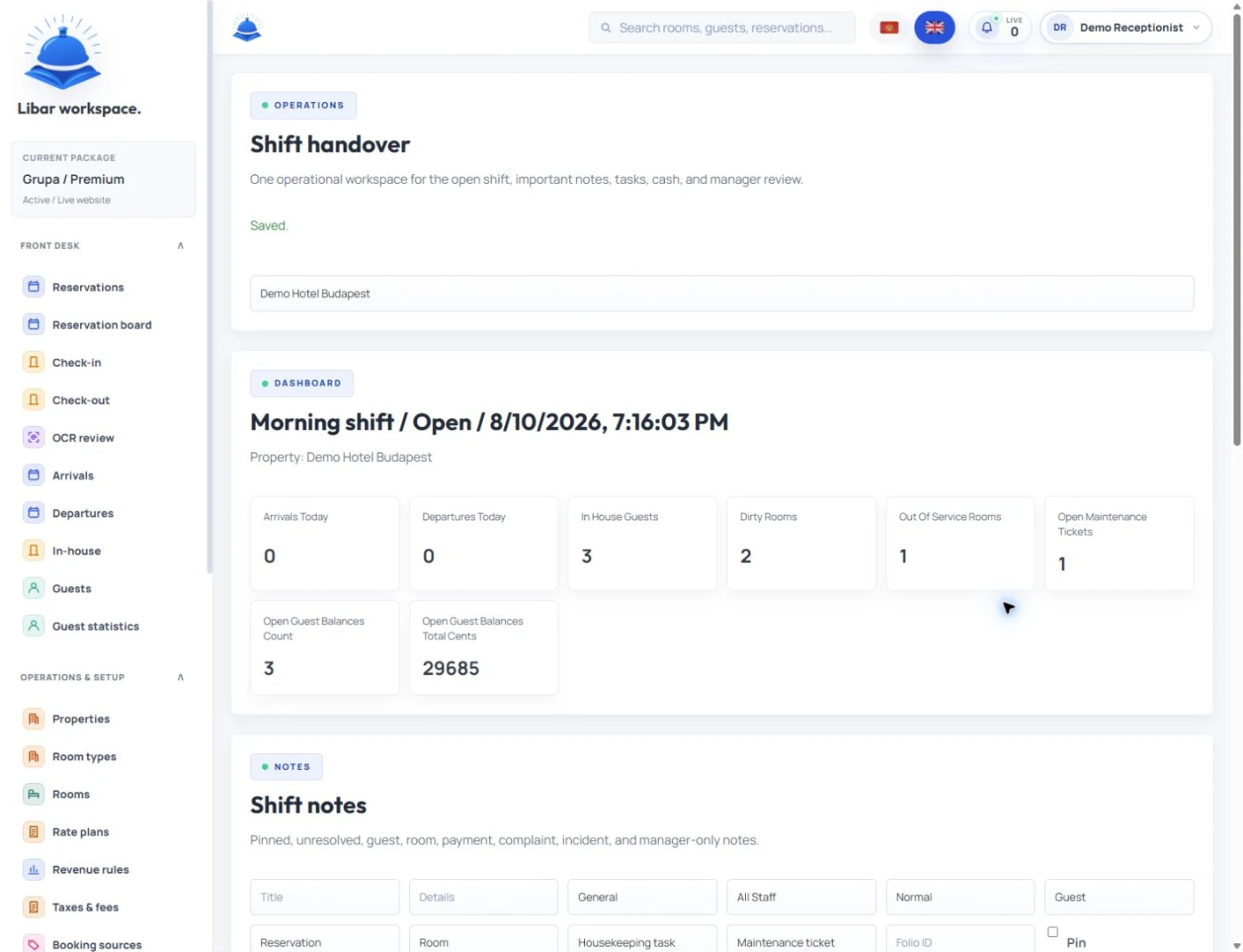
A hotel handover works best when the whole team uses one shared place for notes, tasks, room status, and guest context. Paper can work for a few rooms, but it breaks when shifts change fast or when several people need the same update.
Group chats help with speed.
They are weak for memory.
Messages move up the screen, context gets buried, and staff may not know whether a task was completed. Spreadsheets can organize data, but they often lack task ownership, room history, guest context, and daily workflow visibility.
A shared reception system gives the team one operating layer. Libar fits this workflow because it organizes guest flows, reception tasks, shift handovers, room status, folios, invoices, reports, and daily property work in one place.
Small hotels need a lighter system than large chains
Small hotels do not need complex software that slows the front desk. They need a system that matches the real working day: arrivals, departures, housekeeping updates, guest notes, payments, invoices, maintenance, and manager follow-up.
The best handover process should take minutes.
Not half the shift.
A small team needs clear fields, short notes, task owners, and room-level visibility. The system should help the receptionist run the day, not force the team to manage software for its own sake.
This is where a practical checklist matters. It shows what the hotel needs before choosing the tool.
Paper checklists work until the season gets busy
A paper handover checklist is better than no checklist. It gives the team structure and creates a habit of writing important details before a shift ends.
But paper has a clear downside.
It does not update itself.
If housekeeping changes room status after the checklist was written, reception may not see it. If a manager approves late checkout from another location, the note may stay in a chat. If a guest calls after handover, the next shift may miss the full context.
Paper works for training. A shared digital workflow works better for daily control, especially when the property has more rooms, more staff, or more guest messages.
Montenegro and Adriatic seasonality make handovers harder
Seasonal hotels on the Adriatic coast often face sharp changes in workload. A calm morning can turn into a fast arrival wave, especially with airport transfers, late check-ins, multilingual guests, and last-minute room changes.
This pressure makes handovers more important.
The team has less room for guessing.
Small hotels in Montenegro, villas, and apartment operators often work with lean teams during peak season. One receptionist may handle guest messages, check-ins, room changes, payment notes, local recommendations, and owner updates in the same hour.
A structured handover gives that team a steady rhythm. It turns scattered details into a visible plan.
Hotel front desk handover template
Use this template at the end of each shift.
Shift details
Date:
Shift time:
Outgoing receptionist:
Incoming receptionist:
Manager on duty:
Today’s arrivals
Guest name:
Room/unit:
Arrival time:
Payment status:
Special request:
Room readiness:
Action needed:
Owner:
Today’s departures
Guest name:
Room/unit:
Checkout time:
Open balance:
Invoice needed:
Extras to confirm:
Luggage or transfer note:
Owner:
Room status notes
Room/unit:
Current status:
Issue or delay:
Housekeeping owner:
Maintenance owner:
Ready time estimate:
Guest requests and promises
Guest/room:
Request:
Promise made:
Deadline:
Owner:
Status:
Payments, folios, and invoices
Guest/room:
Open balance:
Deposit or refund:
Invoice request:
Payment issue:
Next action:
Maintenance and blocked rooms
Room/unit:
Issue:
Reported time:
Current status:
Can sell room: yes/no
Owner:
Next check time:
Manager notes
Approval needed:
Complaint to review:
VIP or repeat guest note:
Owner or supplier update:
Risk item:
Example of a clean handover note
Date: 15 June
Shift: 07:00–15:00
Outgoing: Ana
Incoming: Marko
Manager: Jelena
Room 204 requested late checkout until 13:00. Manager approval pending because next guest arrives at 15:00. Marko to confirm with Jelena before 11:30.
Room 108 cleaned and inspected. Guest arrives at 16:00 and requested baby cot. Housekeeping placed cot at 13:20.
Room 302 has open balance of €84. Guest said they will pay by card before checkout. Reception to confirm before 10:00 tomorrow.
Room 305 AC noise reported. Maintenance checked filter but asked for another test after 16:00. Do not assign this room until status changes to ready.
This handover gives the next receptionist the full picture. It shows what happened, what matters, and what still needs action.
A manager should review unresolved items daily
A handover checklist only works when managers review unresolved items. Otherwise, the team writes notes but nobody closes the loop.
Managers should check three things every day:
- Open guest promises
- Rooms with unresolved issues
- Payment or invoice risks
This review does not need to take long. Ten focused minutes can prevent several guest problems.
The manager should also watch for repeated patterns. If late checkout requests keep causing confusion, create a clear rule. If room status keeps changing too late, adjust the housekeeping update process.
Good handovers show the hotel where the system needs improvement.
Use this checklist before choosing hotel reception software
Before choosing hotel reception software, test whether it can support your real handover process. Do not start with a feature list. Start with the work your team performs every day.
Check whether the system can handle:
| Requirement | Needed for small hotels |
|---|---|
| Arrivals and departures overview | Yes |
| Room and unit status | Yes |
| Shift handover notes | Yes |
| Guest records and history | Yes |
| Task ownership | Yes |
| Housekeeping coordination | Yes |
| Maintenance notes | Yes |
| Folios and invoices | Yes |
| Manager visibility | Yes |
| Reports and exports | Useful |
| Integrations | Useful as the property grows |
The right system should make the checklist easier to use. It should not add extra steps without improving control.
A front desk handover checklist gives small hotels a calmer way to run the day. It protects arrivals, rooms, payments, guest promises, and team accountability.
For teams that have outgrown notebooks, spreadsheets, and scattered messages, Libar gives reception one shared place to manage handovers, tasks, room status, guest records, folios, invoices, and daily hotel work. Request a demo from Temelj and review your current reception flow before the next busy period.